

Network keystone jacks
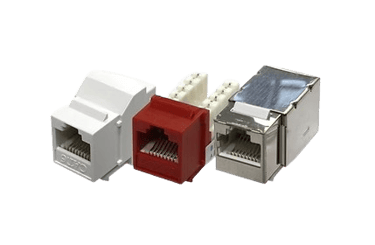
Network Keystone Jacks are modular connectors used in structured cabling systems (Cat6/6A, or Cat7/7A or Cat8) to terminate Ethernet cables and provide a clean, reliable interface for devices. They are the building blocks of patch panels and wall outlets, ensuring flexibility and easy maintenance in LAN setups.
Overview:
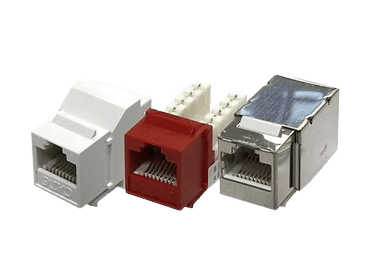
A keystone jack is a female connector used in data communications, the jack is usually mounted in a wall plate or patch panel. A keystone plug is the matching male connector, usually attached to the end of a cable or cord. A principal advantage of keystone connectors is their versatility, several types of keystone jack can be mounted on a single patch panel. They are available in unshielded and shielded forms, and can accommodate cords and cables having various numbers of conductors.
LAN keystone jacks are fundamental modular connectors within structured cabling systems, serving as critical components for terminating Ethernet cables and establishing a standardized interface across various infrastructure elements. These versatile jacks are specifically engineered to integrate seamlessly into patch panels, wall plates, and surface mount boxes, providing a reliable and consistent connection point. As essential building blocks of modern local area network (LAN) infrastructure, their design inherently supports agile and adaptable network deployments, ensuring compliance with industry standards while offering significant benefits in terms of flexibility, scalability, and robust performance.
Application:
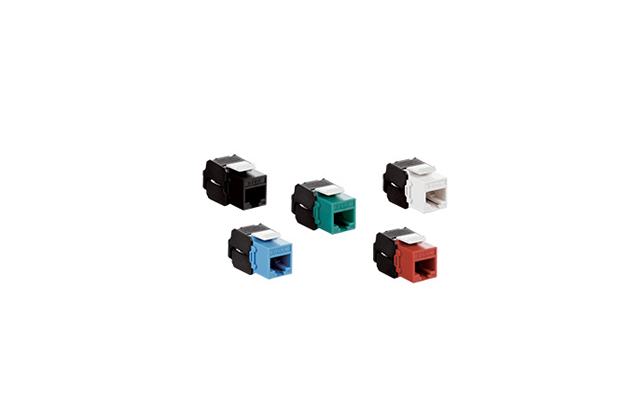
Ethernet RJ45 keystone jacks are available in several versions such 90 degrees to 180 degrees, although keystone jacks are primarily used to offer RJ45 Ethernet connectivity, there are a wide array of different connection options for compatible patch panels. They include standard patch panel offerings like RJ45 Ethernet with various speed and shielding support.
Smaller diameter
Excellent environmental properties
Perfect cable structure with 4 pairs of wires
Network design flexibility
The outer sheath is a PE, PVC and LSZH layer
Conductor Diameter: from 0.57±0.02 to 0.64±0.02mm Copper
Outer Cable Diameter: 6.2mm ± 0.2 mm to 8.7mm ± 0.2 mm
Tested to from 250 MHz to 2000 MHz with guaranteed performance according to Category
100% component test to guarantee the quality
Ethernet Cat6, Cat6A, Cat7, Cat7A or Cat8 Stranded
Available in UTP, FTP and STP
Conductor 23AWG and 24AWG Stranded
Excellent environmental properties
Material outer sheath is PE, PVC and LSZH layer
Meets requirements of IEEE 802.3af and IEEE 802.3at for PoE applications
Temperature Performance[°C]: -30 to +60
Mechanical Performance Test compliance:
ANSI/TIA/ EIA-568-C.2 or EIA-568.2-D
ISO/IEC 11801-1 and ISO/IEC 61156-5
IEC 62821-1 and IEC 60754-1
EN 50173 and EN 50288-4-1
ANSI/TIA-1096-A (FCC Part 68)
EN50173-1:2011
UL, ETL, CE, RoHS
Operation Performance:
Optional Features:


Lenora Innovation
Empowering Change, Enriching Lives
Copyright © 2026 All rights reserved